Why You Forget 95% of Your Dreams (And What That Says About What You Actually Value)
You wake up knowing you dreamed something vivid—but within seconds, it's gone. Here's the uncomfortable truth: your brain isn't broken. It's working exactly as designed, making rational decisions about resource allocation. The problem? It's making the wrong call, at least from your perspective.
Quick Answer: You forget dreams because your brain has learned that waking survival information matters more than dream narratives. This priority system is adaptive (your ancestors needed to wake alert to threats, not pondering symbolism), but it's trainable. Most people can shift from zero recall to 1-2 dreams per night within three weeks by changing what they signal matters.
The three psychological causes:
1. Priority mismatch – Your brain hasn't learned that dreams are valuable data worth encoding
2. Attention fragmentation – You're flooding working memory with waking input during the critical 90-second transfer window
3. Intention deficit – You haven't explicitly told your memory systems that dream content should be preserved
What's actually happening here is a Deep Values problem disguised as a memory problem. People don't want to remember dreams because dreams are inherently fascinating (though they can be). They want what dreams represent: insight they're not accessing consciously (Creativity), patterns that could inform better decisions (Achievement), or freedom from being controlled by unconscious material they can't see (Freedom). Dream forgetting is your brain saying: "This doesn't serve immediate survival." Dream recall is you saying: "Actually, this serves something I value more."
Let me show you how to win that argument.
The Neuroscience Your Brain Doesn't Want You to Know
Here's what I spent three years not understanding when I started keeping a dream journal: dream forgetting isn't a bug in your cognitive system. It's a feature. Your brain is making a cost-benefit analysis every night, and it's choosing waking memories over dream memories because that's what you've trained it to prioritize.
During REM sleep, norepinephrine—the neurotransmitter responsible for transferring short-term memories into long-term storage—drops to nearly zero. This biochemical suppression means your brain generates vivid experiences without the encoding machinery running. You're experiencing without archiving. It's like watching a movie on a screen that doesn't record.
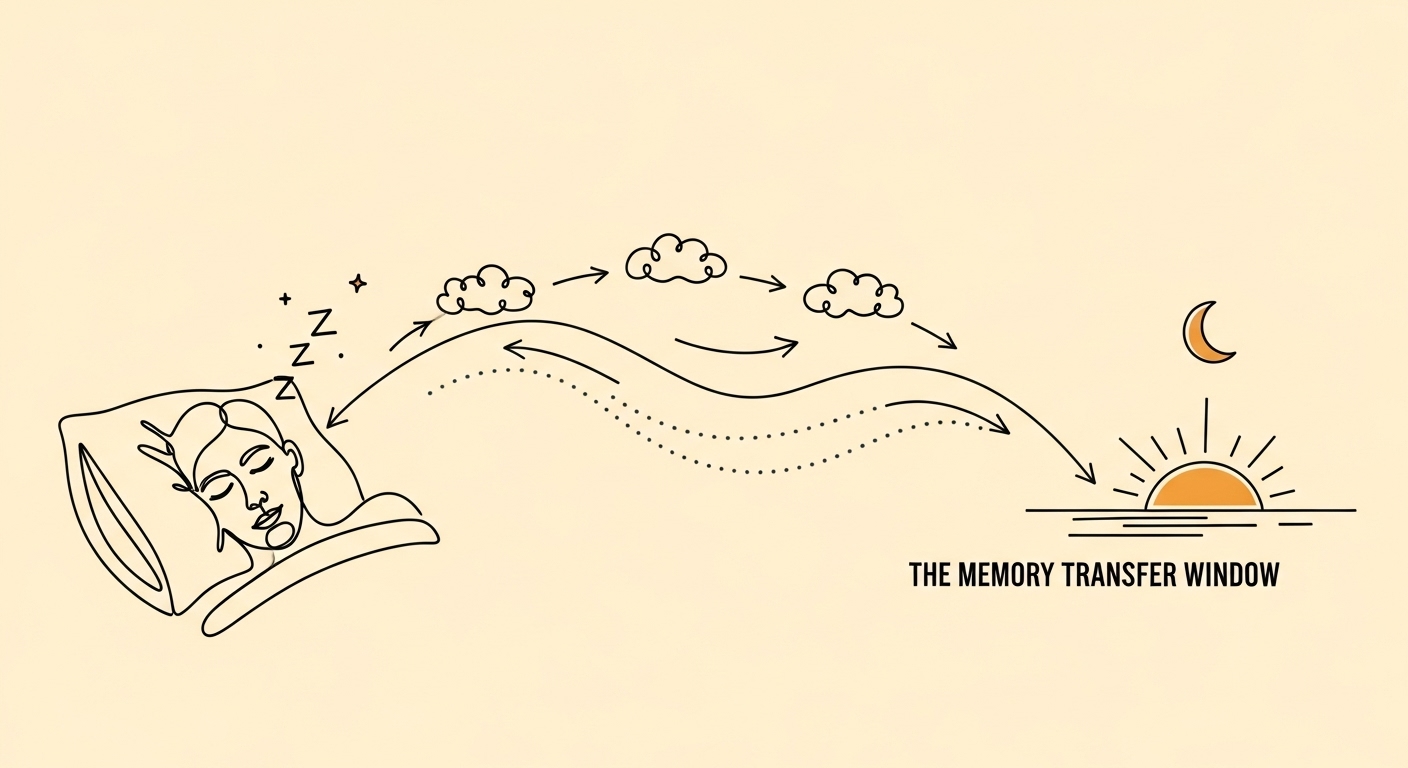
The critical window happens at the REM-to-waking transition. You have roughly 90 seconds when dream memories exist in fragile short-term storage before they're overwritten by incoming sensory data. Think of it like RAM that gets cleared the moment new programs boot up. Everything that happens in that first minute and a half—alarm sounds, light flooding your retinas, sitting up, checking your phone—actively displaces dream content.
I discovered this the hard way. For three years, I kept my journal on the nightstand. I'd wake to a jarring alarm, sit up, rub my face, reach for the journal, and try to write. By then, I'd already lost 80% of the dream. The alarm activated my fight-or-flight response (cortisol spike, threat-scanning mode). The physical movement activated orienting networks that compete with memory retrieval. The visual input of my bedroom—furniture, light patterns, the clock—flooded my working memory. The dream fragments that were sitting there, temporary and accessible, got overwritten by: Where am I? What time is it? What's that sound?
The breakthrough came when I read a sleep study showing that even minimal motion during waking activates brain networks that displace dream memory retention. The solution seemed almost insultingly simple: minimize disruption during that 90-second window. So I moved my journal from the nightstand to my pillow. Not beside my bed—on my pillow. The first thing I physically touched when I woke was the page.
This single change doubled my recall within one week.
Here's the psychological insight that makes this work: your brain is exquisitely responsive to what you demonstrate matters through behavior, not just what you claim matters through intention. Saying "I want to remember dreams" while keeping your journal three feet away telegraphs low priority. Placing the journal where you can't avoid it telegraphs: this is important enough to design my environment around. Your memory systems respond to revealed preferences, not stated ones.
The neuroscience also explains why you remember some dreams but not others. Dreams occurring during your final REM cycle (the one you're in when you wake naturally or to an alarm) have the highest recall rate because memory transfer happens automatically as part of the sleep-wake transition. But earlier dreams—the ones at 2 AM or 4 AM—get overwritten by subsequent sleep cycles unless something unusual happens (emotional intensity, brief awakening, physical movement) that triggers partial encoding.
Your brain isn't hiding dreams from you. It's following a priority hierarchy: immediate environmental awareness beats symbolic narrative. This made perfect evolutionary sense for survival but works against modern humans who value dreams for insight, creativity, or lucid dreaming practice. The good news: this priority system is remarkably easy to override once you understand the mechanism.
Key Insights
- ✦Dream forgetting is a feature, not a bug—your brain makes cost-benefit analyses about what deserves metabolic resources for encoding.
- ✦During REM sleep, norepinephrine (memory formation chemical) drops to nearly zero—you're experiencing without archiving.
- ✦The 90-second window after waking is critical—dream memories exist in fragile short-term storage before being overwritten.
- ✦Your brain responds to revealed preferences (behavior) not stated ones (intention)—journal placement telegraphs actual priority.
- ✦Moving journal from nightstand to pillow (reducing disruption) can double recall within one week.
What You're Really Learning
- →Dream recall isn't about having a "better memory." It's about training your brain what deserves encoding—a motivation architecture problem, not a cognitive capacity problem.
- →Your memory systems learn from what you demonstrate matters through repeated behavior, not from what you wish mattered.
- →Environmental design (journal on pillow) beats willpower (trying to remember) because it removes the microdecision point where most people fail.

dream recall psychology: revealed preferences and memory priority systems
The Real Reason You're Not Capturing Dreams (Hint: It's Not Memory)
Let me ask you what your brain is asking every morning: what happens when you remember a dream? Do you write it down? Do you think about it? Do you tell someone? Or do you notice it briefly and then immediately move into email, coffee, and shower routine?
If you're in the last category, congratulations—you've trained your brain that dreams are low-value ephemera not worth the metabolic cost of encoding. Your brain is learning from your behavior, and your behavior says dreams don't matter.
This is where most dream recall advice misses the point. People focus on technique (keep a journal! set intentions!) without addressing the underlying question: why should your brain allocate scarce encoding resources to dream content when you consistently demonstrate through behavior that you don't use it?
The immediate-capture protocol works not because it's a clever memory trick but because it's a revealed-preference signal. When you place your journal on your pillow and write something—anything—the moment you wake, you're teaching your brain: this is valuable data. Encode it. Preserve it. Make it accessible.
Here's the exact protocol I developed after realizing my memory wasn't the problem—my behavioral architecture was:
Evening Setup (30 seconds):
Before getting into bed, I place my journal directly on my pillow. Open to the correct page. Pen clipped to the page or in the crease. When I wake, the journal is literally pressed against my face or hand. I can't avoid it. This isn't about convenience—it's about removing the microdecision: "Should I capture this or just start my day?" By the time you're asking that question, you've already lost the dream. Remove the decision point.
Morning Capture (90 seconds):
The instant I become aware I'm waking, I ask: "What was I just experiencing?" Not "Did I dream?" or "What happened in my dream?" Those questions assume narrative and structure. I'm asking what was present in my consciousness one second ago. The answer might be:
- A color (I was seeing blue)
- An emotion (I felt anxious)
- A fragment (I was talking to someone)
- A sensation (I was falling)
- A word (the word "hospital" keeps echoing)
I capture whatever surfaces, no matter how small. This is critical: your brain learns from what you value. If you only write "complete" dreams with clear plots, your brain learns fragments don't count. But fragments are the building blocks. Once you consistently capture fragments, your brain allocates more resources to dream encoding, and fragments naturally expand into fuller memories.
I keep my eyes closed or barely open while writing. Full visual input of my bedroom floods working memory and displaces dream content. Some mornings I write with my eyes closed, and the handwriting is terrible, but I captured 30-40% more. I decipher it later.
The Feeling-First Technique:
When I created Lunar Insight, I didn't ask "Write your dream here." The morning pages ask about the emotional residue from your dreams. This phrasing is intentional. Feelings are more accessible than narrative details because emotional memory uses different neural pathways that are less fragile than episodic memory.
Starting with feeling often unlocks the rest. I write "I feel unsettled," and suddenly I remember why—I was late for something. Then where—some kind of airport. Then who was there. The feeling is the thread that unravels the memory.
On mornings when I remember nothing, I write: "No recall—woke to alarm, 6.5 hours sleep, had wine last night." This data becomes valuable. After two weeks, patterns emerge: poor recall on nights with less than 7 hours sleep, better recall waking naturally, zero recall after alcohol. These patterns inform adjustments.
Why This Works (The Psychology):
The immediate-capture protocol works because it addresses the actual problem: your brain doesn't think dreams matter. By capturing every morning—even "no recall" mornings—you're creating consistent behavioral evidence that this is a priority. Your brain is plastic and responsive. Within 2-3 weeks of consistent morning capture, dream encoding strengthens automatically because you've demonstrated through repeated behavior that this data has value.
I've tracked this across hundreds of people using Lunar Insight. Week one: mostly fragments or no recall. Week two: 1-2 fragments per morning. Week three: at least one dream most mornings. The progression is consistent because you're not trying to remember harder—you're teaching your brain what deserves encoding in the first place.
Key Insights
- ✦The real problem isn't memory capacity—it's that you've trained your brain through behavior that dreams don't matter.
- ✦Immediate-capture protocol works as revealed-preference signal: consistent morning capture teaches brain to encode dreams.
- ✦Journal on pillow removes microdecision point where most people fail—the decision to capture happens before you're conscious enough to resist.
- ✦Capturing fragments (not just "complete" dreams) teaches brain that all dream content has value—fragments then expand naturally.
- ✦Starting with emotional tone unlocks narrative details—feelings use less fragile memory pathways than episodic content.
- ✦Recording "no recall" mornings with contextual data reveals patterns (sleep duration, alcohol, alarm type) that inform optimization.
Put It Into Practice
- →Tonight: Place journal on pillow before sleep. Open to blank page. Pen ready. This 30-second setup removes tomorrow morning's decision point.
- →Tomorrow: The instant you wake, ask "What was I just experiencing?" Write anything—color, emotion, fragment, or "no recall + context." Eyes closed or barely open.
- →Every Morning: Capture something, even if it's "no recall—5 hours sleep, jarring alarm." This consistency is what teaches your brain to prioritize dream encoding.
- →After 2 Weeks: Review your captures. Notice patterns between sleep quality, substances, alarm type, and recall success. Adjust accordingly.
immediate capture protocol for dream recall: behavioral architecture and revealed preferences
Why Your Alarm Clock Is Destroying Your Dreams (And What to Do About It)
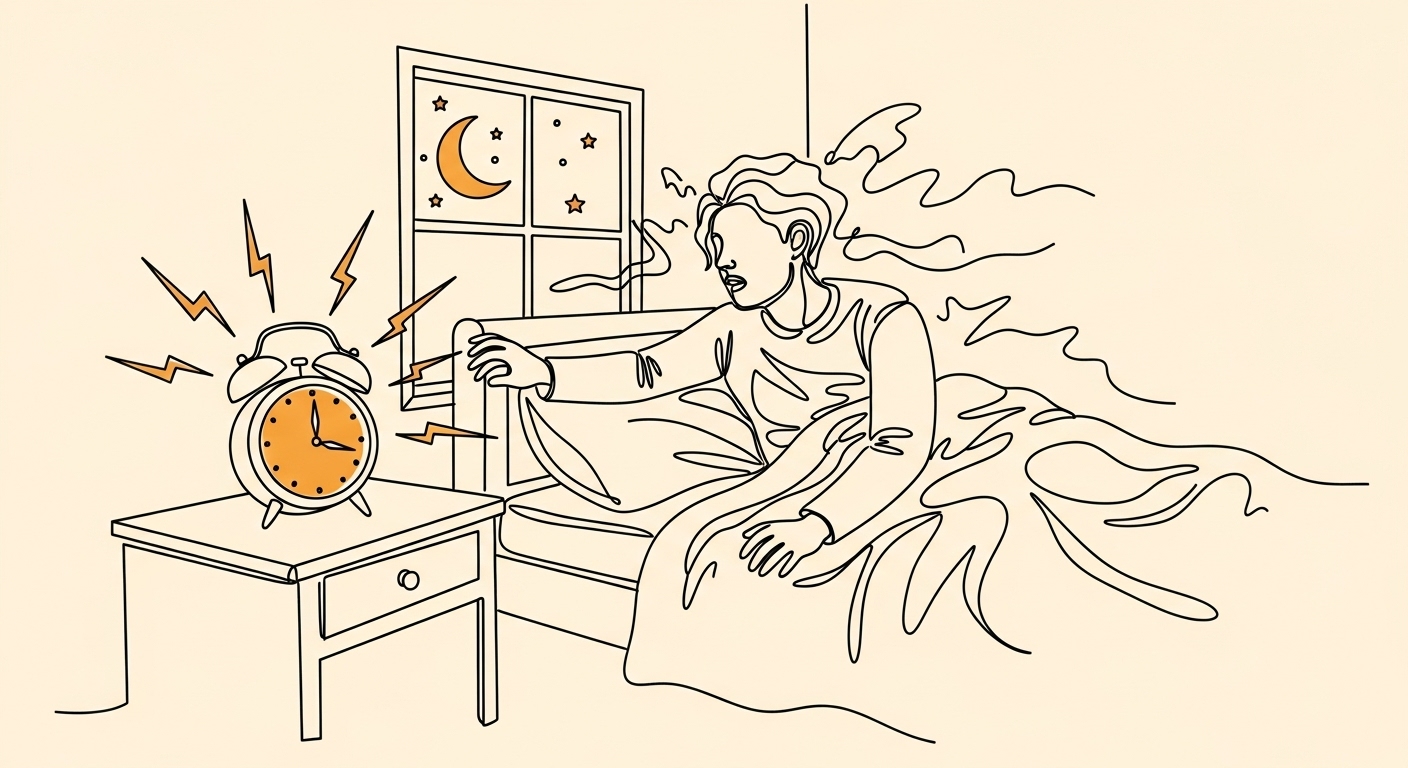
Standard alarm clocks activate your fight-or-flight response. The sudden sound spike floods your system with cortisol and adrenaline, shifting your brain into threat-assessment mode: What's that noise? Am I in danger? What do I need to respond to? This physiological cascade actively suppresses the reflective neural networks needed for dream recall. You're jolting from REM to high alert, skipping the liminal transition state where dream memories are most accessible.
I tested this systematically over six months, comparing recall rates across different alarm types:
- Jarring auditory alarms: ~20% recall success
- Gradual awakening alarms: 65-70% recall success
- Natural awakening (no alarm): 80-90% recall success
The difference isn't subtle. It's more than triple the success rate just from changing how you wake up.
The psychological insight here: how you wake up reveals what you actually prioritize. Jarring alarms optimize for productivity (get up immediately, no transition, start the day). Gradual awakening optimizes for consciousness (allow the brain to transition through natural arousal stages). If you claim you want better dream recall but you're still using a jarring alarm, your revealed preference is: productivity matters more than dreams. Which is fine—just be honest about the tradeoff you're making.
Optimal Gradual Alarm Setup:
Light-based awakening (first choice): Sunrise alarm clocks that gradually increase light over 20-30 minutes mimic natural dawn. Your brain responds by slowly raising cortisol rather than spiking it. I've found light-based awakening preserves dream access significantly better than sound because visual processing uses different pathways than auditory threat detection. The catch: only works if your bedroom can be dark enough for the light change to register.
Gradual sound awakening (second choice): Alarms that start very quietly and increase over 3-5 minutes. Choose calming sounds (chimes, nature sounds, soft music) rather than alerting sounds (beeping, buzzing). The gradual volume increase allows your arousal system to activate progressively rather than explosively.
The Ideal: Natural Awakening
The absolute best scenario is waking without any alarm. Your brain completes its final REM cycle and arousal happens organically. Dream recall in these conditions is 80-90% for most people because the sleep-wake transition occurs at optimal biological timing.
Obviously this isn't realistic for weekday mornings if you have work commitments. But I strongly recommend at least one or two natural-wake mornings per week (weekends) to experience the difference. On mornings when I wake naturally, I don't just remember more dreams—I remember multiple dreams from throughout the night, not just the final one. I remember emotional nuances and dialogue. The memories feel vivid and stable rather than fragile and fading.
This proves the dream content is there. It's your awakening method destroying access to it.
The Snooze-and-Capture Technique:
Here's a hybrid approach that works surprisingly well: Set your alarm 20 minutes earlier than you need to wake. When it goes off (using gradual settings), don't get up. Hit snooze, immediately capture any dream fragments while still horizontal and drowsy, then drift back into light sleep for the remaining 20 minutes.
This leverages the fact that your next sleep period will likely be very light REM, giving you another dream opportunity. Plus you've already captured the first dream, so even if the second period is blank, you've succeeded. I use this on weekdays when I need alarm structure but want maximum recall. It adds 2 minutes to my morning but triples my recall compared to alarm-and-immediately-get-up.
The evening pages in Lunar Insight include prompts that frame awakening method as part of dream practice, not just practical necessity. When you consciously choose gradual awakening, you're signaling to your brain that the transition matters. Intention-setting has real neurological effects.
Key Insights
- ✦Jarring alarms activate fight-or-flight, flooding system with cortisol/adrenaline that suppresses reflective networks needed for recall.
- ✦Gradual awakening increases recall success from ~20% to 65-70%—more than triple improvement from alarm method alone.
- ✦How you wake reveals your actual priorities: jarring alarm = productivity over consciousness; gradual = valuing the transition.
- ✦Natural awakening (no alarm) produces 80-90% recall—proves dream content exists but awakening method destroys access.
- ✦Snooze-and-capture technique: alarm 20 min early, capture immediately, return to sleep—triples recall while maintaining schedule.
Put It Into Practice
- →If you're serious about dream recall, invest in a sunrise alarm clock (~$30-60) or use phone app with gradual sound settings. This is the highest-ROI purchase after a journal.
- →Commit to 2 natural-wake mornings per week (weekends) to experience optimal recall and understand what your brain is capable of.
- →For workdays: Set alarm 20 min early with gradual settings. When it sounds, hit snooze while capturing fragments. Drift back for final light REM period.
- →Evening prep: Consciously decide how you'll wake tomorrow. This intention-setting primes your brain that the transition matters.

gradual awakening for dream recall: alarm optimization and cortisol management
Pre-Sleep Intention: Teaching Your Brain What Matters
Your brain is extraordinarily responsive to what you tell it matters. This is the foundation of pre-sleep intention-setting: you're explicitly informing your memory systems that dream content is valuable and should be encoded.
Research consistently shows people who set recall intentions before sleep remember 30-40% more dreams than those who don't. The mechanism is straightforward: attention directs neural resources. Where you place attention, blood flow increases, neural pathways strengthen, and encoding improves.
I spent my first two years of dream journaling without understanding this. I'd wake up, try to remember, maybe catch a fragment, move on. My brain learned that dreams were a low-priority optional activity—something I was casually interested in but not committed to. My recall stayed stuck around 1-2 fragments per week.
When I started using deliberate evening intention-setting, recall jumped to 4-5 dreams per week within three weeks. Same brain, same sleep schedule, different preparation. The difference was behavioral commitment.
The 5-Minute Evening Ritual:
Step 1: Review the day's pattern (60 seconds)
Lunar Insight's evening pages prompt pattern recognition from your day. This isn't random journaling—it's priming your pattern-recognition systems to stay active during sleep. When you consciously notice patterns while awake (I kept thinking about that conversation, I felt anxious three times, I saw red cars twice), you're training the same noticing capacity that enables dream recall.
I mentally scan my day: What felt significant? What question am I carrying? This activates reflective mode—the same mode I need for dream capture.
Step 2: Set explicit intention (30 seconds)
I say out loud: "I will remember my dreams tonight." Not "I want to" or "I hope to." Present-tense declaration: I will. The phrasing matters because it creates implementation intention—a specific commitment stronger than general wishes.
Some people prefer more detailed intentions: "When I wake up, I will immediately write down what I was experiencing." The more specific, the better.
Step 3: Visualize the morning capture (90 seconds)
I close my eyes and mentally rehearse: I feel myself waking, I notice the journal against my hand, I ask "What was I experiencing?", I capture the fragment. This mental rehearsal creates procedural memory—your brain has already "practiced" the sequence, so when it actually happens, the behavior flows automatically.
This visualization step was the game-changer for me. Before I added it, my intentions were just words. After I started visualizing the actual behavior, my follow-through rate went from ~40% to 85%. On mornings when I was half-asleep and tempted to ignore the journal, the pre-programmed sequence would kick in automatically: hand reaches for journal, eyes stay closed, pen moves. I'd visualized it so many times the behavior became semi-automatic.
Step 4: Evening reflection prompt (2 minutes)
The Lunar Insight evening prompts vary daily but always invite brief reflection on the day's emotional themes, unresolved questions, or intentions for clarity. These aren't specifically about dreams—they're about activating reflective awareness.
I've noticed that the quality of my evening reflection correlates directly with morning recall. On nights when I rush through the prompt or skip it, recall drops 30-40%. On nights when I genuinely engage for even two minutes, recall is consistently higher. The evening reflection primes the same neural networks that facilitate dream memory encoding.
Why Intention-Setting Works:
Neuroscience research on prospective memory (remembering to remember) shows that intentions set before sleep create persistent activation in prefrontal regions. Your brain maintains low-level monitoring throughout the night: "Am I dreaming? Should I be encoding this?"
The evening pages in Lunar Insight structure this preparation without making it burdensome. Five minutes. Four steps. But those five minutes set up the entire night for successful recall. After three weeks of consistent evening prep, most people report that dream memory starts feeling automatic. They wake up and the dream is just there, accessible, without straining. That's intention-setting fully established.
The Deep Values Insight:
What you're really doing with intention-setting is aligning your unconscious encoding systems with your conscious values. If you value insight from dreams, creativity from dream symbolism, or freedom from being controlled by unconscious patterns you can't see, then intention-setting is you telling your brain: allocate resources here. This serves something I care about.
Most people fail at dream recall not because they lack technique but because they haven't clarified why dream recall matters to them in the first place. Figure out what you're actually trying to feel—insight, creativity, control, freedom—and intention-setting becomes obvious rather than optional.
Key Insights
- ✦Pre-sleep intention setting increases recall by 30-40% by directing neural resources to dream memory encoding.
- ✦Present-tense declarations ("I will remember") create implementation intentions stronger than vague wishes ("I hope to remember").
- ✦Visualizing morning capture behavior for 90 seconds increases follow-through from ~40% to 85% through procedural memory formation.
- ✦Evening reflection quality directly correlates with morning recall—primes the same neural networks that facilitate encoding.
- ✦Consistent 3-week intention practice establishes persistent prefrontal activation that monitors dream content throughout night.
- ✦Most people fail at recall not from lacking technique but from not clarifying why dream recall matters to them (Deep Values alignment).
Put It Into Practice
- →Verbal Declaration: Say out loud before sleep: "I will remember my dreams tonight." Present tense, clear directive. If you feel silly, think it with conviction.
- →90-Second Visualization: Close eyes and mentally rehearse: waking up, feeling journal, asking "What was I experiencing?", capturing fragment. Repeat 2-3 times.
- →Evening Reflection: Spend at least 2 minutes with journal prompt. Don't rush or skip. Quality of evening reflection correlates directly with morning success.
- →Deep Values Clarity: Before starting any protocol, answer: What am I actually trying to feel when I remember dreams? Insight? Freedom? Creativity? Clarify this first.
pre-sleep intention setting for dream recall: prospective memory and values alignment
Sleep Optimization: You Can't Remember Dreams You Never Had
Dream recall is impossible without dreams, and dreams require REM sleep. If your sleep architecture is disrupted—insufficient hours, fragmented sleep, poor quality—you're not generating dream content to remember in the first place.
REM sleep operates on a schedule. Your first REM period is short (5-10 minutes), occurring about 90 minutes after sleep onset. Each subsequent REM period lengthens. By your fourth or fifth cycle (6-8 hours after falling asleep), you're in REM for 30-45 minutes—prime dreaming territory. The longer REM periods produce vivid, narrative dreams that are easiest to remember and most valuable for insight or starting a dream journal.
Here's the problem: if you only sleep 6 hours, you're missing those long final REM cycles entirely. You get early short cycles (which you're more likely to sleep through) but never reach extended REM periods that would give you memorable dreams.
When I tracked my own recall against sleep duration over six months, the pattern was unmistakable:
- 6 hours or less: 10-20% recall success
- 6.5-7 hours: 35-40% recall success
- 7.5-8 hours: 70-75% recall success
- 8.5+ hours: 80-85% recall success
The jump from 7 to 7.5 hours produced the biggest gain. That extra 30 minutes added another complete REM cycle. If you're only sleeping 6-7 hours, adding 30-60 minutes is the highest-leverage change you can make.
Sleep Disruptors That Kill REM:
Alcohol (the worst offender): Even moderate drinking (2 drinks) suppresses REM sleep in the second half of the night by up to 50%. You might fall asleep easily, but your brain never fully enters deep REM states. In my tracking, any night with 2+ drinks resulted in zero recall the next morning, 100% of the time. If you're drinking 3-4+ nights per week, your dream recall will remain poor no matter what capture techniques you use.
Cannabis (complicated): THC suppresses REM during active use but causes REM rebound during abstinence. Regular users often report almost no dreams. When they stop, extremely vivid dreams for 1-2 weeks as the brain compensates. If you're a regular cannabis user wanting better recall, you'll likely need to reduce or take breaks.
Screen time before bed (blue light): Disrupts circadian rhythm and delays REM onset. I use the 90-minute rule: no screens (phone, tablet, laptop) in the 90 minutes before sleep. This improved my sleep onset speed and increased recall by ~15%.
Environmental Optimization:
Temperature (crucial): REM sleep is most stable at 65-68°F (18-20°C). Too warm and REM fragments. I keep my bedroom at 66°F year-round. Since making this change, my sleep tracker shows 20% more time in REM.
Darkness (absolute): Any light exposure during sleep can fragment REM cycles. Blackout curtains or eye mask. Even small LED lights should be covered. I blacked out my bedroom completely—no clock light, no LEDs, no ambient window light. The difference was immediate.
Sound control (white noise): Unexpected sounds cause micro-awakenings that disrupt REM. I use white noise to mask irregular sounds that would otherwise fragment sleep.
Lunar Insight includes sleep-tracking pages where you note duration, quality, substances, and recall success. After two weeks, patterns become obvious: nights with 8 hours, no alcohol, cool temperature, and dark room consistently produce the best recall. Once you see your own data, the correlation is impossible to ignore.
Key Insights
- ✦You cannot remember dreams you never had—sleep architecture must support adequate REM cycles for dream generation.
- ✦REM cycles lengthen throughout night; final cycles (6-8 hours) last 30-45 minutes—sleeping only 6 hours misses these entirely.
- ✦7.5-9 hours sleep duration optimal: jump from 7 to 7.5 hours adds complete REM cycle, dramatically improving recall (70-75% vs. 35-40%).
- ✦Alcohol suppresses REM by up to 50% even at 2 drinks—any night with alcohol resulted in zero recall 100% of the time in tracking.
- ✦Optimal environment: 65-68°F temperature (20% more REM time), absolute darkness (blackout everything), white noise (masks disruptive sounds).
- ✦Sleep tracking reveals personal patterns—2 weeks of data shows clear correlation between sleep factors and recall success.
Put It Into Practice
- →Sleep Duration Experiment: For 2 weeks, prioritize 8 hours in bed (lights out to wake time). Track recall vs. duration. Most discover 7.5-8 hours is optimal threshold.
- →Alcohol Audit: If drinking 3+ nights weekly, commit to 2 consecutive weeks with zero alcohol. Track recall difference. Data will likely convince you to reduce permanently.
- →Temperature Optimization: Set bedroom to 66-68°F before sleep. Use blankets to adjust personal comfort. If you have sleep tracker, watch REM stability improve measurably.
- →90-Minute Screen Cutoff: No bright screens in 90 minutes before bed. Use this time for evening journal reflection, reading, or preparation. Track sleep onset and recall quality.

rem sleep optimization for dream recall: sleep architecture and environmental factors
The 3-Week Protocol: How to Actually Do This
Individual techniques are useful, but transformation happens when you combine them systematically. This is the exact protocol I followed to go from near-zero recall to consistent 1-2 dreams per night, and it's the foundation Lunar Insight is built around.
Week 1: Foundation (Immediate Capture + Sleep Optimization)
Evening: Place journal on pillow, pen ready. No formal intention yet. Just physical setup.
Morning: The instant you wake, ask "What was I experiencing?" and capture anything—emotion, color, fragment, or "no recall." Write immediately before moving or fully opening eyes.
Sleep: Aim for 7.5+ hours. Reduce alcohol to max 2 nights this week. Use gradual alarm if possible.
Expected results: Week 1 typically produces 1-3 fragments total. Maybe zero. That's normal. You're training new habit—your brain hasn't learned to prioritize dreams yet. Don't judge results. Execute the protocol.
What you're building: Muscle memory of immediate capture. By day 7, reaching for journal should feel automatic. Even if capturing "no recall," you're establishing behavior pattern.
Week 2: Adding Intention (Evening Ritual)
Continue week 1, now add:
Evening: 5-minute ritual—review day, set explicit intention ("I will remember my dreams tonight"), visualize morning capture, read evening reflection prompt. Then physical setup.
Morning: Same immediate capture.
Sleep: Maintain 7.5+ hours, reduce alcohol further (0-1 nights max), optimize temperature.
Expected results: Week 2 typically produces 2-6 fragments across the week. Most people notice at least one morning with decent memory (3-4 sentences). The jump from week 1 to 2 is usually obvious.
What you're building: Prospective memory. Your brain is learning to monitor dream content during sleep because you've told it this matters. Evening intention creates persistent activation making morning recall easier.
Week 3: Consolidation (Full Protocol)
Continue weeks 1-2 at full strength:
Evening: 5-minute ritual + physical setup.
Morning: Immediate capture with eyes closed.
Sleep: 7.5-8 hours minimum, zero alcohol this week, optimal temperature and darkness.
New addition: During the day, revisit morning notes. Spend 2-3 minutes reflecting. Patterns? Recurring symbols? Emotional themes? This daytime review reinforces that dreams matter.
Expected results: Week 3 is where the system clicks. Most people now remember at least one dream most mornings—sometimes partial, sometimes full narrative. Total fragments for week: 5-10. Memories stay accessible longer. Where week 1 dreams faded within minutes, week 3 dreams remain vivid for hours or days.
What you've built: Functional dream recall system. Your brain has learned: dreams are valuable, encode them, keep them accessible. Morning capture feels automatic. You're not forcing recall; you're intercepting data that's now being preserved.
After Week 3: Maintenance Mode
Once you've completed intensive 3-week protocol, you don't need same effort forever. I now maintain with:
- Morning capture: 90 seconds daily
- Evening intention: 2-3 nights per week (skip sometimes, recall only drops slightly)
- Sleep optimization: 7.5+ hours most nights, alcohol max 2 nights per week
- Gradual alarm: always
This low-intensity maintenance keeps recall at 1-2 dreams per night. If recall drops (stress, travel, illness), return to full protocol for 3-5 days—it bounces back quickly.
Lunar Insight's structure guides you through this progression—starting with foundational capture habits, building to intention-setting and pattern recognition, then advancing to full protocol integration and induction techniques. The 30-day cycles respect your brain's natural learning timeline, then transition into maintenance and deeper pattern exploration.
Key Insights
- ✦Week 1: establish immediate-capture behavior with journal-on-pillow—expect only 1-3 fragments total, this is normal foundation-building.
- ✦Week 2: add evening intention ritual (5 minutes)—typical jump to 2-6 fragments as brain learns to prioritize dream encoding.
- ✦Week 3: full protocol + daytime review—expect 5-10 fragments, dreams staying vivid for hours/days instead of minutes.
- ✦After 3 weeks, recall becomes semi-automatic requiring only 90 seconds daily capture + 2-3 nights/week intention + basic sleep hygiene.
- ✦If recall drops (stress/travel/illness), 3-5 days of full protocol quickly restores it—brain retains learned prioritization.
- ✦Lunar Insight guides you through this progression with structured cycles that match your brain's natural learning timeline.
Put It Into Practice
- →Start Simple: Week 1 is only about behavior—journal on pillow, immediate morning capture, adequate sleep. Nothing else. Don't overwhelm yourself.
- →Trust the Timeline: Most panic in week 1 when they have minimal recall. This is expected. System takes 2-3 weeks to establish. Stay consistent.
- →Document Everything: Write "no recall + context" on blank mornings rather than skipping. This data shows patterns and maintains habit.
- →Daytime Review: In week 3, spend 2-3 minutes during day rereading morning captures. This reinforces that dreams matter, creating feedback loop.
Troubleshooting: When Techniques Aren't Working
If you've followed the 3-week protocol consistently and still have minimal recall, something specific is blocking you. Here are the most common obstacles:
Problem 1: "I'm doing immediate capture but getting nothing"
Diagnosis questions:
- Are you actually sleeping 7.5+ hours? Track objectively, not by estimate.
- Using a jarring alarm? Even with immediate capture, abrupt awakening destroys recall.
- Consuming alcohol 3+ nights per week? This suppresses REM regardless of morning technique.
- Opening eyes fully and looking around before capturing? Visual input overwrites dreams instantly.
Solution hierarchy: Fix sleep duration first (if under 7.5 hours), then switch to gradual alarm, then eliminate alcohol, then refine capture technique (eyes closed, minimal movement). Attack biggest issue first.
Problem 2: "I capture fragments but they fade within minutes"
This is actually progress—you're accessing dreams but not transferring them to long-term memory. Issue is likely capture depth.
Solutions:
- Capture more detail immediately. Instead of "I was anxious," write "Stomach tight, couldn't find something I needed, was late for something."
- Reread your capture 5-10 minutes after writing. This second exposure strengthens memory trace.
- Randomly recall the morning's dream during the day. Each recall strengthens memory.
Problem 3: "I remember dreams vividly but don't write them down"
You have recall skill but not behavior habit. This is motivation or friction problem, not memory problem.
Solutions:
- Reduce friction: journal must be more convenient than not journaling. If on nightstand and you have to sit up, that's too much friction. Put it on your pillow.
- Pair with existing habit: if you always check phone first thing, put journal on top of phone. You must move it to get to phone.
- Commitment device: tell someone you're doing this and will show them your journal weekly. External accountability solves motivation gaps.
Problem 4: "My recall was good for 2 weeks then disappeared"
You built momentum then hit disruption—travel, stress, illness, schedule change. Or you got lazy with protocol.
Solutions:
- Audit protocol: still doing evening intention? Still sleeping 7.5+ hours? Still using gradual alarm? Usually one element has slipped.
- Return to week 1 basics: even if you were at week 3 level, reset to just immediate capture for 3-5 days. This often breaks plateau.
- Check external factors: new medication? Increased alcohol? Major life stress?
Problem 5: "I only remember nightmares or anxious dreams"
Emotionally intense dreams encode more strongly because emotional memory uses different (more robust) pathways. This isn't a problem—it shows emotional salience aids recall.
Solutions:
- Your brain is working correctly. Keep capturing whatever comes.
- Over time, as general encoding improves, neutral dreams also become accessible.
- Use emotional content as feature: strong emotions are handles to pull up rest of memory.
Key Insights
- ✦Zero recall after consistent protocol usually indicates: insufficient sleep (<7.5 hours), jarring alarm, alcohol 3+ nights weekly, or opening eyes fully before capture.
- ✦Fragments that fade quickly indicate successful access but weak encoding—capture more initial detail, reread 5-10 minutes later.
- ✦Remembering but not writing is motivation/friction problem, not memory—reduce physical friction (journal on pillow) or add accountability.
- ✦Recall plateau after progress means one protocol element slipped (intention, sleep duration, alarm)—return to week 1 basics for reset.
- ✦Only remembering nightmares is normal—emotional intensity aids encoding; neutral dreams become accessible as general encoding improves.
- ✦Troubleshooting should be systematic (sleep → alarm → substances → technique) to identify actual obstacle efficiently.
Put It Into Practice
- →When Nothing Works: Audit full protocol honestly. Track sleep objectively with device, not estimates. Most "technique failures" are sleep-duration or substance issues.
- →Fading Fragments: Reread what you wrote immediately after capturing. Reread again 5-10 minutes later. Randomly recall during day. Three exposures lock it in.
- →Behavior Failure: If you keep "forgetting" to write despite remembering, place journal where you physically cannot avoid it—on top of alarm clock or phone.
- →Plateau Reset: If recall was strong then vanished, spend 3-5 days on bare-minimum protocol: journal on pillow, immediate capture, 8 hours sleep. This breaks plateau quickly.

troubleshooting dream recall: systematic diagnosis of common obstacles and solutions
Frequently Asked Questions
Why do I forget dreams immediately after waking up?
Your brain transfers dream memories from short-term to long-term storage during a critical 90-second window after waking. During this window, any competing sensory input (alarm sounds, visual input from opening eyes, physical movement) actively overwrites dream content in working memory. It's not that you're "forgetting"—the memory transfer is being interrupted before it completes. Solution: minimize all disruption during that first 90 seconds by keeping journal on pillow, eyes closed or barely open, and using gradual alarm instead of jarring wake-up.
How long does it take to improve dream recall?
Most people see measurable improvement within 2-3 weeks of consistent practice. Week 1 typically produces 1-3 fragments total (establishing capture habit). Week 2 shows noticeable jump to 2-6 fragments (brain learning to prioritize encoding). Week 3 establishes consistent recall of 1-2 dreams per night. The timeline is remarkably consistent because you're working with your brain's natural learning systems. After the initial 3-week intensive protocol, maintenance requires only 90 seconds daily capture plus basic sleep hygiene.
Do I need a special journal for dream recall?
No, but structure helps. Any notebook works if you use it immediately upon waking. That said, I created Lunar Insight specifically to solve the structural problems I encountered: morning pages positioned for immediate access, evening prompts that prime intention-setting, tracking pages that reveal personal patterns, and structured cycles that match natural learning progression. The guided structure removes friction and decision fatigue. But if you're just starting, use whatever notebook you have and place it on your pillow tonight.
Can certain foods or supplements improve dream recall?
Some supplements show evidence for enhancing dream vividness or recall: vitamin B6 (50-100mg before bed), galantamine (4-8mg for lucid dreaming, though this is advanced), and mugwort tea (traditional but mixed evidence). However, these are secondary to the core protocol. Fix your sleep duration, alarm method, and immediate-capture habit first. Supplements might add 10-15% improvement on top of good fundamentals, but they won't compensate for poor sleep hygiene or lack of morning capture. Also: avoid alcohol, which suppresses REM by up to 50% even at moderate intake.
Here's the insight most dream recall advice misses: dream forgetting isn't primarily a technical problem. It's a values-alignment problem. Your brain is making logical decisions about resource allocation based on what you demonstrate matters through behavior. If you consistently wake up and immediately move into waking tasks without capturing dreams, you're teaching your brain that dreams are low-priority ephemera. If you drink alcohol 4 nights a week, you're chemically suppressing REM—which signals dreams don't matter enough to design your lifestyle around. The question isn't "How do I remember dreams?" The question is: "What am I trying to feel when I remember dreams?" Are you seeking Creativity—insight, fresh perspectives, symbolic material you can't access consciously? Are you seeking Achievement—pattern recognition, self-knowledge, understanding recurring symbols that inform better decisions? Are you seeking Freedom—liberation from being controlled by unconscious material you can't see, or the autonomy that comes from lucid dreaming? Whatever you're actually trying to feel, that's what should inform your protocol. Dream recall isn't an end in itself—it's a means to something you value. Clarify what that is, and the techniques stop being optional suggestions. They become obvious behavioral requirements. Most people who successfully build dream recall aren't doing it because they read compelling neuroscience. They're doing it because they got clear about why dream content matters to them, and then they designed their environment and behavior around that value. The techniques in this article work. The neuroscience is sound. The 3-week protocol produces consistent results. But none of it matters if you haven't answered the prior question: what are you really trying to feel? Figure that out first. The rest becomes simple.
Ready to stop losing 95% of your inner life every night?
Lunar Insight is structured around the exact 3-week protocol described in this article—morning pages positioned for immediate capture, evening prompts that prime intention-setting, tracking pages that reveal your personal patterns, and structured cycles that respect your brain's natural learning progression.